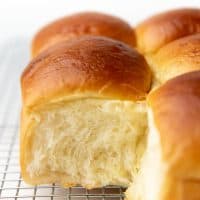
Ingredients:
Tangzhong
- 60 mL water ¼ cup
- 60 mL milk ¼ cup
- 23 g bread flour 2 tbsp
Japanese Milk Bread
- Tangzhong room temperature
- 120 mL milk ½ cup, lukewarm
- 7 g active dry yeast 2 – 2 ¼ tsp
- 50 g sugar ¼ cup
- 15 g dry milk powder 2 tbsp
- 1 egg
- 350 g bread flour about 2 ⅔ cups, spoon and leveled
- 1 tsp sea salt
- 58 g unsalted butter softened, 4 tbsp / ½ stick
Instructions:
Tangzhong
- Place the water in a small saucepan. Add the bread flour and whisk until you have a smooth mix with no lumps. Add the rest of the milk and whisk to combine.
- Heat over medium heat while whisking constantly until the mixture thickens. The resulting mixture should have a thick, pudding-like consistency.
- Scrape the mixture into a bowl and then cover with plastic wrap. Make sure the plastic wrap is touching the surface of the tangzhong to prevent a skin from forming on top.
- Allow the tangzhong to cool to room temperature.
Japanese milk bread dough
- In your mixing bowl, place the lukewarm milk and dissolve about 1 tsp of the sugar in the liquid. Sprinkle the yeast over the milk and stir gently to mix. Allow the milk + yeast mixture to stand for about 10 – 20 minutes until the yeast is activated. The mixture should become bubbly and frothy on the surface.
- Once the yeast is activated, add the milk powder (if using), the rest of the sugar, tangzhong, the egg, flour, and finally the salt.
- Using a spatula, mix the dough to combine the ingredients and to help form a scraggly dough.
- With the dough hook attached to your mixer, knead the dough for about 5 minutes on a low speed (speed 2 or 3). The dough will be very sticky and stick to the sides, but continue mixing and the dough will start to come together.
- After 5 minutes of kneading, add the butter in 3 – 4 additions, mixing for about 20 seconds in between. Scrape down the sides and the bottom of the bowl to make sure the dough mixes well.
- Once all the butter is incorporated into the dough, turn up the speed to 4 – 5 (medium speed) and knead for a further 5 – 7 minutes. Scrape the bowl once or twice while kneading.
- The dough should become smooth, satiny and pull off cleanly from the sides of the bowl.
- Place the dough on a lightly floured surface and shape the dough into a ball. Then place the dough back in the mixing bowl and cover with plastic wrap.
- Keep the bowl in a warm place and allow the dough to double in size (about 1 – 2 hours, depending on the weather/ambient room temperature).
- When the dough has proofed in a warm place, you can transfer it to the fridge for a couple of hours just to make it a little easier to handle. THIS IS AN OPTIONAL STEP.
- Alternatively, place the bowl in the fridge and let it slow proof for about 12 hours. The dough will also be easy to handle when chilled.
- Once the dough is proofed and you’re ready to shape the dough, prepare the loaf pan. Butter 1 – 4.5 x 8.5 inch loaf pan and dust the pan with flour. If making dinner rolls, butter a 9 or 8 inch square cake pan, and dust the sides with flour. Set aside until needed.
- Turn the dough out onto a lightly floured surface and press all the excess air out of the dough.
Japanese milk bread loaf
- Weigh the dough, and divide it into 4 equal portions.
- Roll out each dough portion into a six inch (approximately) square.
- Fold the opposite corners of the square in towards the middle.
- Roll up this piece of dough, starting from the pointed end. Make sure you roll up the dough firmly, and a little tightly. If it’s too loose, you may end up with large holes in the baked bread.
- Once you’ve rolled up the dough to the top, fold the pointed edge in and pinch the seam to seal.
- Place the rolled up dough in the dough pan, seam side down. There will be 4 rolls per loaf pan.
- Repeat with all the dough portions and place them in the loaf pan.
- Cover the loaf pan with plastic wrap and let the dough proof in a warm place, until doubled in size. This can take about 1 – 2 hours depending on the ambient room temperature. The dough should rise to just below the top of the loaf pan.
Leave a Reply